



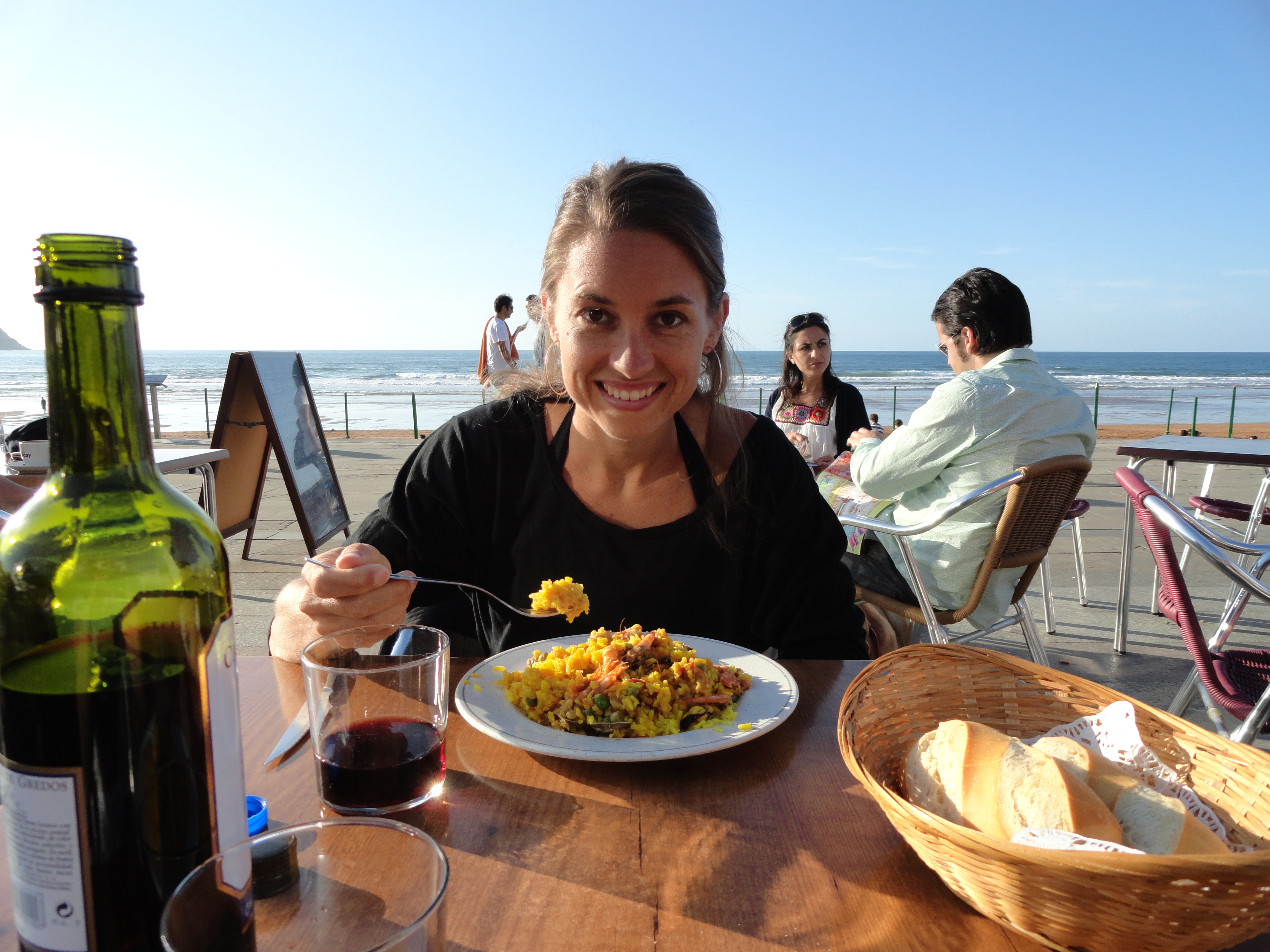
Since I was a teenager I’ve wanted to go to Europe. I’m 33 years old and I’ve just now made it a reality – I’m in Spain. In the decade and a half I’ve had to fantasize about what this continent might be like, I’ve conjured many things: I was sure the people were much more intelligent and civilized than Americans. I was positive the landscape would be idyllic, the architecture stolidly ancient, and the pace slow. More than all of that, though, I believed the food would be pure and unadulterated by toxic pesticides, weird preservatives or anything else. I just knew that there would be an unwavering respect for the integrity of breakfast, lunch, second lunch and dinner. Well, I can tell you that I’ve been rather, er, surprised by what the realities are in Spain.
Let’s start with the people. I’m a big fan of mullets (short hair on top, long in the back). I mean we all are – there are entire websites devoted to them – but Spaniards take them to a whole new level. I’ve seen at least a dozen Spanish muchachos whose mullets were replete with 1 to 10 solid, foot-long dreadlocks, or “The Dreaded Spanish Mullet”. Here’s a picture in case you can’t even imagine what this offense might look like.
As for the people, let’s just say they’re relaxed. As long as they’re not rock climbing, in which case many of them are screaming obscenities at the top of their lungs a lot of the time. But when they’re NOT climbing… For instance, yesterday I saw a man (with a mullet) with sunscreen only half rubbed into his back, hiking around with only a Speedo and shoes on. And I can assure you that the only person who was embarrassed by that situation was me.
I was instructed by a new Spanish friend to stop saying “perdon” (“excuse me”) every time I sort of get in someone’s way because it makes me seem weird – Spaniards don’t care if I’m in their way. And when you order dinner at a restaurant (at no earlier than 9:30pm, by the way), the waiter will greet you with a casual, “Di me.” Or, “Tell me.” If a waiter came up to us in America and said, “Tell me what you want,” it would be bad. Which brings me to the food. While I was right about the idyllic landscape, the incredibly beautiful architecture and the slow pace of things here, I was way off on the quality of the food.
If you like pork, you should come to Spain. On one menu there were 5 options, 4 of which were a pork product with a salad. An iceberg lettuce salad. If you like iceberg lettuce, you should come to Spain. And if you don’t ever want to buy an organic item again, come to rural Spain. Spain exports 99.6% of their organic produce, a lot of which are olive products, to the rest of the world. Apparently, they don’t need it. I’m not even sure if most of the people outside of the big cities would know what organic produce is.
There are preservatives, vegetable oil, and colorings in almost everything packaged. I saw one jar of olives that contained 8 different preservatives. And they don’t tell you the name of the preservative – it’s just “conservadoro E-202″ or some other E number. Having said that, I will say that I have not seen high fructose corn syrup once or hydrogenated oils, so that’s good.
And the meat? We bought some meat called “Solomillo fileteado”, but we’re still not sure what it was. Not even our Spanish-speaking friends could tell us because it turns out “solomillo” and “fileteado” both basically mean “fillet”. We think it was chicken. And ground beef? Almost non-existent (like I said, they like their pork over here). My friends bought some ground beef in the normal Styrofoam packaging covered in plastic, and the ingredients went something like this: ground beef, soy protein, corn, vegetable fiber, soy oil, conservadoro E-202, conservadoro E-222, spices, and coloring. What?! We just wanted to make some burgers! I didn’t eat it – I stuck with my mystery meat. Besides the meat being mis-labeled or full of unnecessary ingredients, I haven’t been able to figure out what their animal husbandry practices are over here. I sort of don’t want to know.
So, eating Paleo in Spain? Not that great, but it’s sort of possible – I’m definitely trying. That is, if you consider eating a lot of french fries as “trying to eat Paleo”. For your starches, you’re not going to find a sweet potato or a squash in many markets. For your fats, you’d think that avocados would be an easy find. Not necessarily true. BUT the olive oil is fantastic, and they cook all their meats with it in restaurants. And the red wine is cheap and satisfying. The patatas fritas (french fries) they serve with every meal are, of course, fantastic, and are my only non-Paleo indulgence so far. When you mix it all together – the pork loin, iceberg lettuce salad, olive oil and balsamic vinegar, patatas fritas, and your new mulleted friends, it makes for a pretty entertaining and enjoyable meal.

9 Comments
Luis
I am Spaniard and I live in Spain. This post does not really reflect how we live in Spain, except for the “Dime” (I hate it) and 09:30 for the dinner (I usually have dinner at 22:30-23:00). Interesting anyway.
Some advices:
- Do not stop saying “Perdon” (You will not look weird by any means). Be more selective choosing your friends.
- You can get a list of all E-things here. http://histolii.ugr.es/EuroE/NumerosE.pdf. This list is in Spanish, but they come from the European Union, so it should be easy to find the English version.
- “Solomillo fileteado” is a tenderloin steak
Which part of Spain are you living at ? I bet you are in the South.
Neely
Thank you, Luis, for the list and the advice. That list is invaluable! I apologize for any misrepresentation of the way you live in Spain – I was just going off my experiences so far, which have been good except for the lack of organics and the overabundance of preservatives, etc. in the food. I will continue saying perdon and I will try to pick my friends more wisely :) I am in Rodellar, north of Huesca. Anyway, thanks for the clarifications.
Luis
I lost my bet twice ! Huesca is north, so you are in the north of the north so to speak. Very nice place.
No need to apologize. I understand that everyone´s experience is different and yours is as valid as mine.
26 miles away from Rodellar there is a nice place, Biescas, to get organic beef. See http://www.otropirineo.com
Also in Huesca province (not sure how far away from Rodellar), there is another place (Alvaro Bajo) to get organic fruit and vegetables. See http://www.ecohuerto.com/
Feel free to drop me an email if you need any help to survive your adventure in Spain.
Neely
Thank you! I will definitely check those out on my next grocery trip.
Marlina Eckel
That stupid E list of additives came about when the EU monopolized the food industry over there. That happened when I was living in Austria and I had this guide which highlighted which “E”s were unhealthy and which were just benign. It is a terrible situation, as it pulls the ability away from a normal person to properly read a label. The European Union RUINED the European food supply. At least in Austria, but I would assume in Spain as well. Back in the early 90s Austria had tons of pride in locally produced foods, they were high quality, without many additives or none at all. Grass fed meats and cheeses, organic or low pesticide agriculture. Then the EU determined that foods should be shipped all over the Union. Austrians cannot just eat what is produced in their country, in fact, they aren’t allowed to even carry the sticker “produced in Austria” anymore. That used to be a label of pride, as one knew that Austria had high food standards. The markets are forced to import foods that were produced in Holland (where they don’t have good standards) Can you believe that they even decide, in Belgium!, on which days the farmers in the WHOLE Union can plant. Lots of Austrian farmers used to farm by Rudolf Steiner biodynamic methods, now that is not allowed. Austrians fought GMO tooth and nail…to the last bone, but sure enough the EU shoved it on them. I just heard that the EU approved cloned meats…. You aren’t in Spain, food wise. You are in the EU. It’s a complicated animal… probably a pig, pumped up with industry chemicals, toxins, and corruption, all hiding behind a “E”.
Neely
Wow, Marlina. Thank you for that info. This is such disappointing news… Why would they outlaw biodynamic farming methods???
Lakshmi
Wow – As a Biodynamic Farmer living in the South of Spain I am left scratching my head in regard to the previous comments about Austria outlawing BD farming methods. Never have I heard this and am certain that my BD farming colleagues in Austria are carrying on as always. We have been involved with BD farming in the UK, Italy, Holland,Germany,France and now Spain but have never heard such nonsense as being told what days we are allowed to plant. (Of course as a BD farmer we do determine which days we do certain tasks, including planting, based on planetary cycles/forces!)But being told by the EU when we can plant? Nope. How would they even enforce that??? Very curious as to where this information is being obtained and would love to see verifiable sources to confirm it. Oh, and in all the countries in the EU I’ve been in the origin of food (ie what country it came from) is clearly labeled on all produce,dairy,meat,etc. We live in a fairly small town and even here the major grocery store chains have clearly marked and pride filled offerings of locally produced products.
You’ve already been given the resource to find out what all the E-numbers are. Granted the system is difficult for the average consumer to navigate, but in my opinion no worse than the average consumer in the US being knowledgeable about the multitude of chemicals and additives listed on food labels there. I do nod my head in agreement about the ground beef and all the crap that is in it however. That is simple to bypass though by just going to the butcher and asking them to grind some beef for you. Organics are more difficult to find in smaller towns but not impossible. Nearer to larger cities it is not so challenging. The current economic crisis here has sadly forced many smaller independent sellers and growers out of business but there is a committed force out there working to get organics to market.
Eating paleo in Spain is hard. This is very true. (I am also celiac which is a double whammy in difficult, though I will say that in my experience Spain has some of the best labeling of gluten free foods and the awareness of gluten in restaurants that I have found over here. Awareness not always being equivalent to access mind you!) I came across your blog in a search for paleo resources in Spain interestingly enough. Almond flour (or even raw almonds for a desperate attempt at grinding my own flour) coconut flour, coconut oil and many other ingredients that are so widely used in paleo and GF recipes are rare birds here.
Paco
Luis, do you think that Southern people are the only one in Spain who either never say “perdón,” or ask you “Dime” in restaurants? Your comment does show some prejudice against Andaluces. Or is it envy what it shows? People like you is what Neely should really avoid.
Encarni
Neely, I hope you have the opportunity to visit the south (and please forgive Luis ignorant comments). You will love the food and the people.